Why do people have a hard time taking funny music seriously? If a song makes us laugh, it's dismissed as a novelty, like Randy Newman's "Short People" or Loudon Wainwright's "One Man Guy." Never mind that these songwriters can also compose a love song as well as anyone else. As soon as they get a chuckle out of us, we assume they're lightweights, just out for a laugh. We don't have the same problem accepting a blend of drama and humor when we go to the movies. They're called dramedies, and James L. Brooks has won a few Oscars making them. So why the aversion to humor in popular music?
I don't know, but it's hurt Fountains of Wayne. Led by the songwriting team of Chris Collingwood and Adam Schlesinger, they're known for their 2003 hit "Stacy's Mom," and that's about it. Due to the success of that single, they've been relegated to the joke bin with Ray Stevens and "Pac Man Fever," but they deserve more. Personally, I think "Stacy's Mom" is brilliant, and not such a bad legacy, but there's a lot more to Fountains of Wayne.
Their second album, Utopia Parkway, was such a flop Atlantic Records dropped them afterwards. Why more people didn't buy it, I don't understand. Why radio wouldn't play it, well, it keeps me up nights. Like all the band's music, it walks a tightrope between being riotously funny and painfully true. Nobody has written about youthful angst with this much insight and wit since John Hughes, but you can't sing along to John Hughes, unless you count that really cheesy "Twist and Shout" scene from Ferris Bueller's Day Off, and I don't.
Fountains of Wayne's songs feature fully developed characters in familiar situations. "Utopia Parkway" introduces us to a narrator plotting his deserved rock stardom. "Laser Show" takes us on a (stoned?) trip to the local planetarium. "Prom Theme" is the story of a magical night as told by Electric Light Orchestra. Each one of these songs is hilarious, but also crafted with great care, and the melodies linger after the laughter fades.
The key song is "Red Dragon Tattoo." In it, our young hero gets inked so his crush will notice him. "Will you stop pretending I've never been born/Now I look a little more like that guy from Korn?" he pleads. Sure, it's funny, but we've all kind of been there, and the song rocks like a great old Cars track.
But the important thing is that when Fountains of Wayne aren't being funny, they're still a great band. "Troubled Times" deserves to be a classic, with its hummable chorus and lyrics about a lost love. The finest writers are the ones who best observe details and find creative, surprising ways to incorporate them. Schlesinger and Collingwood are great writers, populating their world with cover bands and custom vans and driving home on the L.I.E. Here's a test: listen to one Fountains of Wayne song, just one, and try and tell me you haven't met somebody just like one of their characters. It might even be you.
TODAY'S RECOMMENDATION: "Red Dragon Tattoo" by Fountains of Wayne
AVAILABLE ON: Utopia Parkway; iTunes
Friday, September 26, 2008

Thursday, September 25, 2008
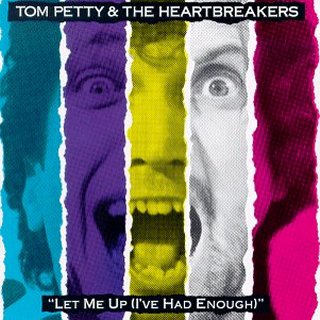
UNDERRATED ALBUMS: Great Album, Scary Cover
Tom Petty's blockbuster Greatest Hits CD was a neat collection of his hits from 1976 to 1993, and he had more than a few. But he has been an even more dependable album artist than hitmaker, especially now that mainstream radio has relegated him to the pop nursing home along with Paul McCartney and James Taylor. Petty has never released a bad album, a major accomplishment that often goes unnoticed. But if an album doesn't launch any hit singles, it's going to get short shrift, and one album was not represented at all by Greatest Hits.
That album was Let Me Up (I've Had Enough), an effort that failed to catch fire in 1987. The album's lead single, "Jammin' Me," made a disappointing showing (by Petty's standards), as did other singles from the record. "Jammin' Me", co-written by Petty with Bob Dylan and Heartbreakers guitarist Mike Campbell, isn't Petty's best, but it's a solid, meat-and-potatoes rocker that still sounds better than most artists on their best days.
The rest of Let Me Up (I've Had Enough) is just as strong, and usually more interesting. "Runaway Trains" is the most modern-sounding song on the album, and therefore, the most dated. But ignore the synthesizers, and it's one of the finer Petty/Campbell compositions. "It'll All Work Out" is a pretty ballad, chiming with acoustic guitars and mandolin. The rest of the album is mostly stripped-down rock, the Heartbreakers' forte, the highlights being "Think About Me," the raucous title track, and the Johnny Cash-inspired "Self Made Man."
The Heartbreakers, who produced the album themselves, were somewhat disappointed by the final product. Drummer Stan Lynch complained that many of the best tracks were left off (he has a point; check out the Playback boxed set to hear some of them). But Let Me Up (I've Had Enough) is probably the simplest and loosest album of Petty's post Southern Accents career. No concept, no orchestras, no Jeff Lynne, just Petty and co. ripping it up as only they can do. Had enough? Never.
TODAY'S RECOMMENDATION: "It'll All Work Out" by Tom Petty and the Heartbreakers
AVAILABLE ON: Let Me Up (I've Had Enough); iTunes
That album was Let Me Up (I've Had Enough), an effort that failed to catch fire in 1987. The album's lead single, "Jammin' Me," made a disappointing showing (by Petty's standards), as did other singles from the record. "Jammin' Me", co-written by Petty with Bob Dylan and Heartbreakers guitarist Mike Campbell, isn't Petty's best, but it's a solid, meat-and-potatoes rocker that still sounds better than most artists on their best days.
The rest of Let Me Up (I've Had Enough) is just as strong, and usually more interesting. "Runaway Trains" is the most modern-sounding song on the album, and therefore, the most dated. But ignore the synthesizers, and it's one of the finer Petty/Campbell compositions. "It'll All Work Out" is a pretty ballad, chiming with acoustic guitars and mandolin. The rest of the album is mostly stripped-down rock, the Heartbreakers' forte, the highlights being "Think About Me," the raucous title track, and the Johnny Cash-inspired "Self Made Man."
The Heartbreakers, who produced the album themselves, were somewhat disappointed by the final product. Drummer Stan Lynch complained that many of the best tracks were left off (he has a point; check out the Playback boxed set to hear some of them). But Let Me Up (I've Had Enough) is probably the simplest and loosest album of Petty's post Southern Accents career. No concept, no orchestras, no Jeff Lynne, just Petty and co. ripping it up as only they can do. Had enough? Never.
TODAY'S RECOMMENDATION: "It'll All Work Out" by Tom Petty and the Heartbreakers
AVAILABLE ON: Let Me Up (I've Had Enough); iTunes
Wednesday, September 24, 2008
UNDERRATED ALBUMS: He Thinks Too Much So We Don't Have To
Paul Simon's
All of this makes Hearts and Bones sound like a troubled album. If anything, it's Simon at his best. Forgotten in the wake of the blockbuster
Simon later referred to the Hearts and Bones period as the time he finally began "to understand about writing...when to use ordinary language and when to use enriched language." You can hear this poetic blend of the elevated and the conversational in the title track, now a favorite among Simon aficionados. It's the story of Paul's brief marriage to Carrie Fisher. Simon has always had a way with words, but my God, listen to this song and tell me it isn't his absolute peak as a lyricist. "The arc of a love affair," his eloquent phrase, has never been outlined with more grace or humor or profound sadness. It starts with the wedding: "The act was outrageous/The bride was contagious/She burned like a bride." The song's middle section is a dialogue between the two lovers, and Simon shows a playwright's skill in showing us, not telling us, why these two will never agree on anything. In the end, man and woman "return to their natural coasts" to recover from one other.
Hearts and Bones aches all over. "Train in the Distance" is also about a divorce, this time with children caught in the middle. But being a Paul Simon album, there's also some fussy intellectualism to go with the melodrama. "When Numbers Get Serious" equates the power of love with the certainty of mathematics. Simon is so stuck in his own head, he even wrote two-- two-- songs called "Think Too Much." Mr. Simon, it seems, has an acute sense of irony. "Think Too Much (a)" is a funky, funny look at youthful confusion. "Think Too Much (b)" is more somber, climaxing with this touching family scene: "And in the night/My father came to me/And held me to his chest/He said 'there's not much more that you can do/Go on and get some rest.'"
There's plenty of striking, lovely moments like this on Hearts and Bones. Perhaps the most effective song is "The Late Great Johnny Ace." In this musical autobiography, Paul links his childhood sadness over the death of minor rocker Johnny Ace with the much later murder of John Lennon. I wasn't alive to experience Lennon's death, but hearing Simon's take is shattering enough.
The album isn't the creamy folk-jazz of 1975's Still Crazy After All These Years, and it predates Simon's later experiments with world music and Broadway. Still, Hearts and Bones is full of little sonic surprises; some doo-wop here, a Philip Glass string arrangement there. Simon was punished on the charts for throwing so much at the wall, but most of it stuck.
TODAY'S RECOMMENDATION: "The Late Great Johnny Ace" by Paul Simon
AVAILABLE ON: Hearts and Bones; iTunes
Tuesday, September 23, 2008
UNDERRATED ALBUMS: He Was Smooth, He Was Rough, He Was More Than Enough
By the late 1980s, even Bob Dylan no longer believed in Bob Dylan. His albums had become increasingly labored and unimaginative, his live shows often descended into tuneless chaos, and he appeared withdrawn and sullen to even his closest friends. In his memoir, he remembers telling himself: "...I'm a '60s folk troubadour, a folk-rock relic, a wordsmith from bygone days, a fictitious head of state from a place nobody knows. I'm in the bottomless pit of cultural oblivion." Critics mostly agreed, giving poor marks to late '80s records like Knocked Out Loaded and Down in the Groove. Had the Spokesman of His Generation become the class clown?
Not quite. Even the disappointing Knocked Out Loaded contains some genius ("Brownsville Girl," co-written with Sam Shepard). If Bob was so down and out, how could he give that brilliant, jolting, punk rock performance on David Letterman's show? How could he surprise everyone by singing the hell out a Gershwin standard? The truth is, Bob's gift has never left him for too long. Just when he was contemplating retirement, he enjoyed a resurgence. First by participating in the Traveling Wilburys, and then with 1989's Oh Mercy, a moody return to critical favor.
Under the Red Sky, released the next year, did not share this success. One of the worst-selling albums of Bob's career, it was condemned by reviewers as a new creative low point. "The drag is that Dylan doesn't have much to say," groaned Rolling Stone, "or a really memorable way to say it." Other critics seized on the slick modern production by Don and David Was, known for their work with other geezer acts like the Rolling Stones and Bonnie Raitt. The album's apparent lack of depth, not to mention the unusual presence of guest artists, reinforced the idea that the River Bob had run dry.
I don't understand why Under the Red Sky has been so cruelly dismissed. True, Dylan would return in much sharper form with Time Out of Mind later in the decade, starting a hot streak that is still going strong. But to me, Under the Red Sky is one of Bob's most relaxed and enjoyable albums. It's silly and playful one moment ("Wiggle Wiggle"), quiet and philosophical the next ("God Knows"). "Unbelievable" rocks lean and mean, "Cat's in the Well" is a catchy blues, and "Born in Time" sports one of his most enticing melodies. When I listen to the record, I hear Bob Dylan dismantling his art to see if he can put it back together, bringing it all back home before he sets back out again.
As for the production, it is smoother than we're used to for a Dylan record, but not to its detriment. It's polished but also clean and sharp. Other producers had tried to modernize Bob by smothering him in synthesizers and canned echo (see Empire Burlesque). But the Was Brothers kept Bob's cranky croak front and center, making sure we knew who we were listening to. Dylan claims to have had little input into the record's sound, but maybe that's a good thing. It was certainly the producers' idea to have George Harrison lend his slide guitar to the title track, which alone makes the album worth its list price.
Dylan was so "completely disillusioned" by the experience he didn't record any new material for seven years, leaving the impression that Under the Red Sky almost killed his career. I disagree. I think Under the Red Sky is the sound of Bob Dylan recharging his batteries, quietly rediscovering his own creative spark and gearing up for one of rock's greatest twilight resurgences. Thank God he didn't let the sun set too early.
TODAY'S RECOMMENDATION: "Born in Time" by Bob Dylan
AVAILABLE ON: Under the Red Sky; iTunes
Not quite. Even the disappointing Knocked Out Loaded contains some genius ("Brownsville Girl," co-written with Sam Shepard). If Bob was so down and out, how could he give that brilliant, jolting, punk rock performance on David Letterman's show? How could he surprise everyone by singing the hell out a Gershwin standard? The truth is, Bob's gift has never left him for too long. Just when he was contemplating retirement, he enjoyed a resurgence. First by participating in the Traveling Wilburys, and then with 1989's Oh Mercy, a moody return to critical favor.
Under the Red Sky, released the next year, did not share this success. One of the worst-selling albums of Bob's career, it was condemned by reviewers as a new creative low point. "The drag is that Dylan doesn't have much to say," groaned Rolling Stone, "or a really memorable way to say it." Other critics seized on the slick modern production by Don and David Was, known for their work with other geezer acts like the Rolling Stones and Bonnie Raitt. The album's apparent lack of depth, not to mention the unusual presence of guest artists, reinforced the idea that the River Bob had run dry.
I don't understand why Under the Red Sky has been so cruelly dismissed. True, Dylan would return in much sharper form with Time Out of Mind later in the decade, starting a hot streak that is still going strong. But to me, Under the Red Sky is one of Bob's most relaxed and enjoyable albums. It's silly and playful one moment ("Wiggle Wiggle"), quiet and philosophical the next ("God Knows"). "Unbelievable" rocks lean and mean, "Cat's in the Well" is a catchy blues, and "Born in Time" sports one of his most enticing melodies. When I listen to the record, I hear Bob Dylan dismantling his art to see if he can put it back together, bringing it all back home before he sets back out again.
As for the production, it is smoother than we're used to for a Dylan record, but not to its detriment. It's polished but also clean and sharp. Other producers had tried to modernize Bob by smothering him in synthesizers and canned echo (see Empire Burlesque). But the Was Brothers kept Bob's cranky croak front and center, making sure we knew who we were listening to. Dylan claims to have had little input into the record's sound, but maybe that's a good thing. It was certainly the producers' idea to have George Harrison lend his slide guitar to the title track, which alone makes the album worth its list price.
Dylan was so "completely disillusioned" by the experience he didn't record any new material for seven years, leaving the impression that Under the Red Sky almost killed his career. I disagree. I think Under the Red Sky is the sound of Bob Dylan recharging his batteries, quietly rediscovering his own creative spark and gearing up for one of rock's greatest twilight resurgences. Thank God he didn't let the sun set too early.
TODAY'S RECOMMENDATION: "Born in Time" by Bob Dylan
AVAILABLE ON: Under the Red Sky; iTunes
Monday, September 22, 2008
UNDERRATED ALBUMS: Still Mightier Than Most
Music critics, myself included, are mostly full of crap. At least, that's what you say, dear reader and music lover. What do critics know? All we do is overpraise weird, unlistenable hipster bands and slam your heroes. I don't suppose you put any more faith in your fellow consumers of music. Some of the stuff America sends rocketing to the top of the charts makes me want to clean my ears out with a letter opener. It puzzles us all when others don't hear genius in all the same places we do. This week, this music snob will introduce you to some records I think have gone criminally underpraised.
The only thing consistent about Elvis Costello's music over the past thirty years has been its undimmed emotional intensity. His late '70s records burned with nerdy fury, giving us punchy new wave rock songs that were too tuneful to be called punk. "Big Tears" and "Radio Radio" seethe infectiously, sounding every bit as angry as anything out of CBGB. Over the years, Elvis opened up his sound to include country, jazz, and classical elements, to name only a few. Costello's youthful anger may have lessened, just supplemented by new, equally potent emotional outbursts. North, his ravishing collection of piano ballads, may be romantic, but it's not mellow. Listen to the words, and the former Declan MacManus has a lot of raw emotion he just can't keep inside.
1991's Mighty Like A Rose is as emotional as any record he's made. On the surface, it's a shiny piece of early '90s pop/rock, one of the slickest of Costello's career. Following in the footsteps of 1989's Spike, Mighty Like a Rose continued to shave the rough edges off of Costello's sound in the pursuit of something much more polished. Baroque touches color the album. It bursts with horns and strings and overdubbed backing vocals, banjos and sound effects and anything else that was around. But underneath this pop party atmosphere, Elvis was still pissed off and passionate, barking some of his most biting lyrics ("I am your stupid lover, you wretched ghoul.")
Critics were generally not kind. While Rolling Stone gave it a pass, if not a rave, others were quick to proclaim it as Elvis' nadir. Robert Christgau graded Mighty Like a Rose a "C+", writing, "the good songs are overblown tragedies, the bad ones overblown trifles." All Music Guide said "there's so much going on that it's hard to get to the core of the songs." The dense production, credited to Mitchell Froom and Kevin Killen, received the brunt of the criticism, though the buck always stops with the guy whose name is on the album.
These critiques aren't entirely off base. The album is needlessly cluttered and fussy. A bizarre song like "Hurry Down Doomsday (The Bugs Are Taking Over)" would benefit from a more straightforward rock arrangement. "Playboy to a Man" could have been a great Little Richard rave-up, but it ends up sounding like something from Pee Wee's Playhouse. One wonders what Mighty Like A Rose might have sounded like if it had been quick and dirty like 1986's Blood and Chocolate or 2004's The Delivery Man. 1991 saw Elvis stuck in between these career high points, drowning in overproduction.
That's the bad news from an album overflowing with good news. "So Like Candy" is the best of the dozen or so songs Costello co-wrote with Paul McCartney. The song sparkles with Costello's sardonic flair and McCartney's melodic grace. "The Other Side of Summer" parodies the Beach Boys and even mocks McCartney's old songwriting partner, but with a killer hook and dark humor John would have loved. "All Grown Up" has a melody for the ages and "Sweet Pear" sounds like a moodier partner to the Beatles' "Don't Let Me Down."
Mighty Like A Rose is at times beautiful, baffling, and frustrating. It's appropriate it should end with a song that is all those things at once. The waltzing "Couldn't Call it Unexpected No. 4" is perhaps the finest piece of music Costello has ever composed. The lyric is evocative but ultimately inscrutable ("The sudden chill where lovers doubt their immortality/As the clouds cover the sky"). Costello's performance here is a marvel, too, seamlessly alternating between delicate and gruff. But the song's strange, circus-like arrangement is a major distraction, with cheesy trumpets and plinking keyboards carrying on as if writing the best song of your career is some kind of joke.
Costello is really onto something here, most of the time, and his idiosyncratic songcraft shines through the thicket of studio gloss. This is one time Costello couldn't be saved from his own eccentricities. Without them, though, would we love him as much as we do?
TODAY'S RECOMMENDATION: "Couldn't Call it Unexpected No. 4" by Elvis Costello
AVAILABLE ON: Mighty Like A Rose; iTunes
The only thing consistent about Elvis Costello's music over the past thirty years has been its undimmed emotional intensity. His late '70s records burned with nerdy fury, giving us punchy new wave rock songs that were too tuneful to be called punk. "Big Tears" and "Radio Radio" seethe infectiously, sounding every bit as angry as anything out of CBGB. Over the years, Elvis opened up his sound to include country, jazz, and classical elements, to name only a few. Costello's youthful anger may have lessened, just supplemented by new, equally potent emotional outbursts. North, his ravishing collection of piano ballads, may be romantic, but it's not mellow. Listen to the words, and the former Declan MacManus has a lot of raw emotion he just can't keep inside.
1991's Mighty Like A Rose is as emotional as any record he's made. On the surface, it's a shiny piece of early '90s pop/rock, one of the slickest of Costello's career. Following in the footsteps of 1989's Spike, Mighty Like a Rose continued to shave the rough edges off of Costello's sound in the pursuit of something much more polished. Baroque touches color the album. It bursts with horns and strings and overdubbed backing vocals, banjos and sound effects and anything else that was around. But underneath this pop party atmosphere, Elvis was still pissed off and passionate, barking some of his most biting lyrics ("I am your stupid lover, you wretched ghoul.")
Critics were generally not kind. While Rolling Stone gave it a pass, if not a rave, others were quick to proclaim it as Elvis' nadir. Robert Christgau graded Mighty Like a Rose a "C+", writing, "the good songs are overblown tragedies, the bad ones overblown trifles." All Music Guide said "there's so much going on that it's hard to get to the core of the songs." The dense production, credited to Mitchell Froom and Kevin Killen, received the brunt of the criticism, though the buck always stops with the guy whose name is on the album.
These critiques aren't entirely off base. The album is needlessly cluttered and fussy. A bizarre song like "Hurry Down Doomsday (The Bugs Are Taking Over)" would benefit from a more straightforward rock arrangement. "Playboy to a Man" could have been a great Little Richard rave-up, but it ends up sounding like something from Pee Wee's Playhouse. One wonders what Mighty Like A Rose might have sounded like if it had been quick and dirty like 1986's Blood and Chocolate or 2004's The Delivery Man. 1991 saw Elvis stuck in between these career high points, drowning in overproduction.
That's the bad news from an album overflowing with good news. "So Like Candy" is the best of the dozen or so songs Costello co-wrote with Paul McCartney. The song sparkles with Costello's sardonic flair and McCartney's melodic grace. "The Other Side of Summer" parodies the Beach Boys and even mocks McCartney's old songwriting partner, but with a killer hook and dark humor John would have loved. "All Grown Up" has a melody for the ages and "Sweet Pear" sounds like a moodier partner to the Beatles' "Don't Let Me Down."
Mighty Like A Rose is at times beautiful, baffling, and frustrating. It's appropriate it should end with a song that is all those things at once. The waltzing "Couldn't Call it Unexpected No. 4" is perhaps the finest piece of music Costello has ever composed. The lyric is evocative but ultimately inscrutable ("The sudden chill where lovers doubt their immortality/As the clouds cover the sky"). Costello's performance here is a marvel, too, seamlessly alternating between delicate and gruff. But the song's strange, circus-like arrangement is a major distraction, with cheesy trumpets and plinking keyboards carrying on as if writing the best song of your career is some kind of joke.
Costello is really onto something here, most of the time, and his idiosyncratic songcraft shines through the thicket of studio gloss. This is one time Costello couldn't be saved from his own eccentricities. Without them, though, would we love him as much as we do?
TODAY'S RECOMMENDATION: "Couldn't Call it Unexpected No. 4" by Elvis Costello
AVAILABLE ON: Mighty Like A Rose; iTunes
Subscribe to:
Posts (Atom)

 Posts
Posts